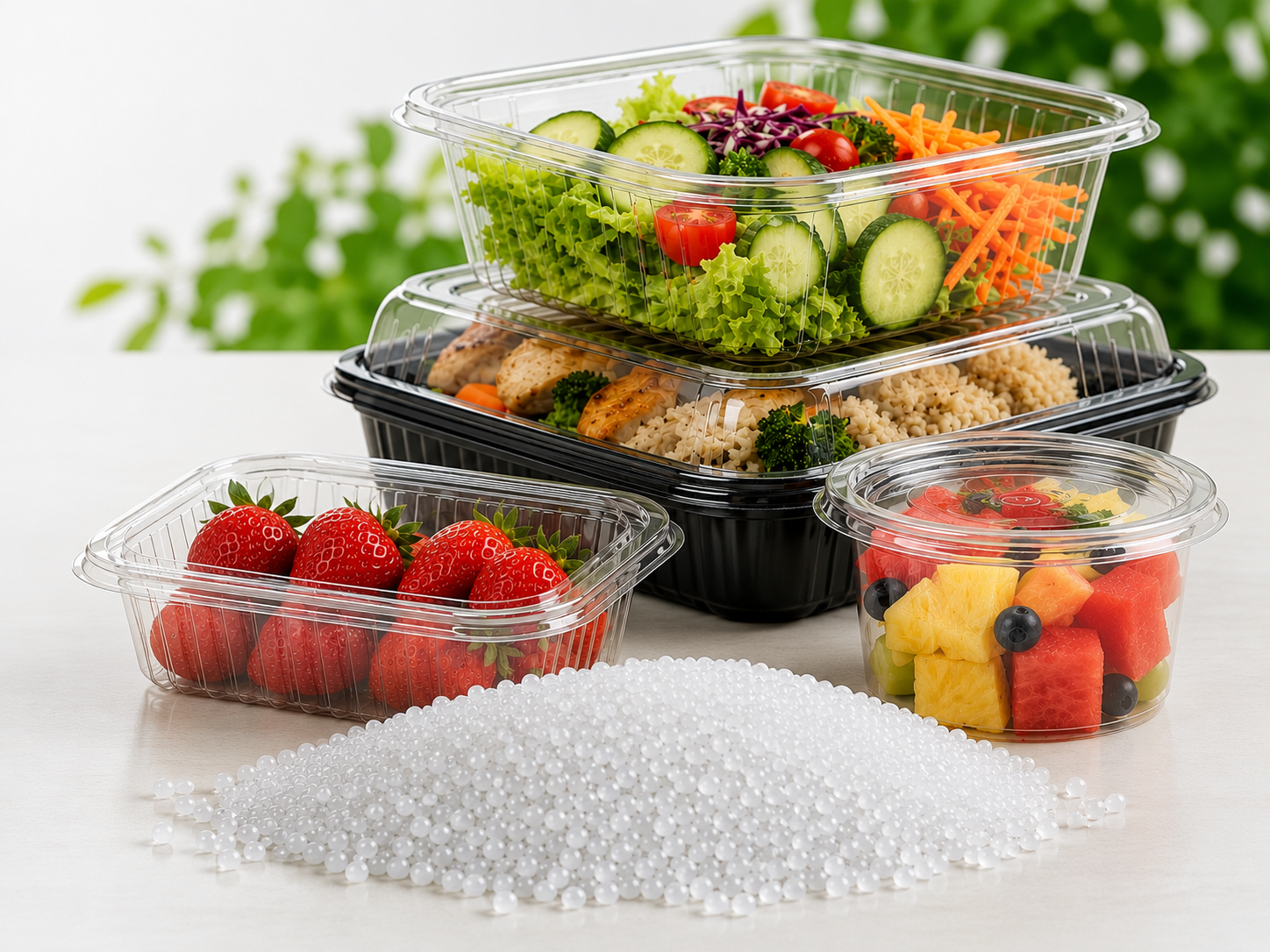
This product development started with a phone call from one of India’s largest thermoformed food packaging companies. They were struggling to meet new EPR and export requirements that demanded recycled content — and nothing was working.
Every attempt to use recycled PP led to cloudy sheets, strange odor, and migration test failures. That’s when they reached out to us at Garbag Rebits: “You guys talk about technical recycling — can you make it happen for us?”
Challenge
When the client came to us, they had already run multiple failed trials with recycled PP. Each attempt ended in either poor clarity, odor issues, or migration test rejections. They needed a way to include more than 50% recycled content — but without losing the look, feel, or performance of their export-grade packaging. The real challenge wasn’t just achieving recycled content — it was making it truly food-safe, process-stable, and globally acceptable.
- Odor and contamination removal:
- Clarity & consistency:
- Mechanical strength & formability:
- Migration compliance
How we help ?
Garbag Rebits engineered a custom food-grade recycled PP compound through in-depth R&D, process refinement, and controlled additive technology.
Step 1: Feedstock Selection & Pre-Processing
- Sourced food-contact-only post-consumer PP (cups, trays, caps).
- Multi-stage hot washing, float–sink separation, and odor neutralization.
- Controlled MFI at 3.5–4.5 g/10 min, optimized for sheet extrusion.
Step 2: Decontamination & Polymer Refining
- Used vacuum degassing twin-screw extruder with high-torque setup.
- Added chain extender and odor absorber for molecular balance.
Step 3: Sheet Extrusion & Blending
- Blended 55% recycled PP with 45% virgin food-grade PP.
- Maintained ±5% thickness uniformity across 800 mm sheet width.
- Improved gloss, haze, and color to match virgin PP levels.
Step 4: Thermoforming Optimization
- Tuned heating zone profile and vacuum draw settings.
- Achieved deep draw ratio of 1:2.5 without cracking or whitening.
- Zero failures in sealing and stacking tests.
Step 5: Validation & Testing
- Overall migration: <10 mg/dm² (EU 10/2011) .
- • Impact strength: 95% of virgin PP.
- • Odor rating: <2 (ASTM E544)
- • Passed drop & stack tests for export transport
Outcome
- Achieved 55% recycled PP in food-grade thermoforming containers.
- Passed all migration and odor tests for export markets (EU & USFDA compliant).
- Maintained clarity, sealing strength, and smooth production with zero line stoppages.
- Replaced 40 MT virgin PP monthly, creating measurable commercial and environmental gain.
- Client expanded the solution to three additional product lines, reducing their carbon footprint by 28%.
Process Gallery
.png)