The Background
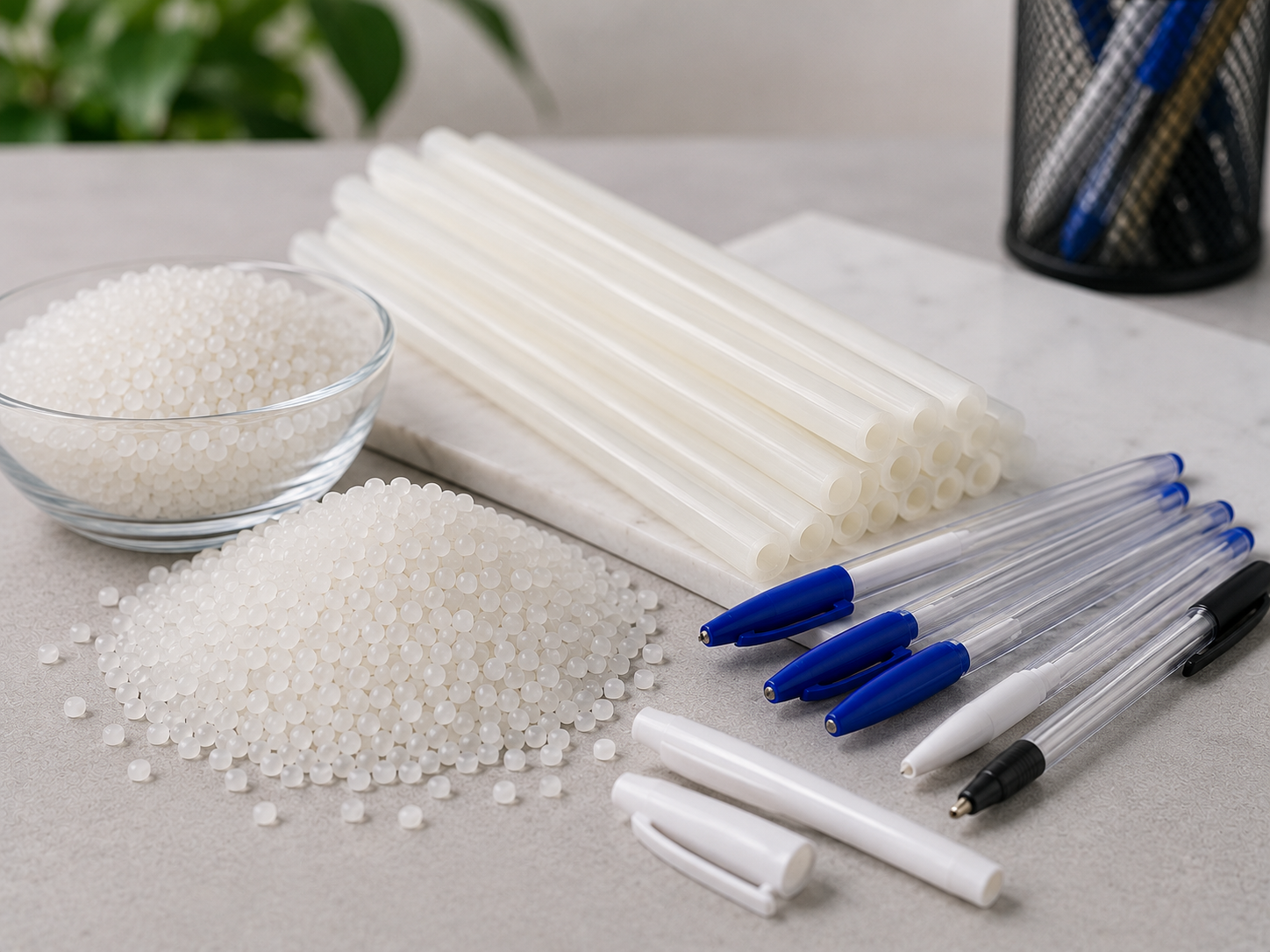
The pen manufacturing industry depends heavily on high-speed injection molding systems where precision, flow consistency, and material appearance play a critical role. Most pen components are produced on multi-cavity molds, meaning the polymer must flow rapidly and uniformly across all cavities without creating defects.
The client required a natural-color polypropylene (PP) material with extremely high MFI (Melt Flow Index) for smooth and efficient molding performance.
However, the recycled PP materials available in the market were creating several challenges such as:
- Poor flow in multi-cavity molds
- Uneven filling between cavities
- Haziness in natural color appearance
- Flow marks and surface defects
- Increased rejection during production
- Longer cycle times and unstable processing
The biggest technical challenge was the material flow itself.
The available recycled PP had an MFI of around 2, which was far too low for high-speed pen manufacturing applications. For proper cavity filling and production efficiency, the client required a material with significantly higher flow characteristics.
The challenge presented to us was:
"Can recycled PP be engineered from low-flow material into a high-MFI precision molding solution without compromising appearance and process stability?"
This became a highly technical material engineering project focused on transforming recycled polymers into a performance-grade molding compound.
Our Approach
We conducted extensive formulation development, melt-flow optimization, and processing trials to engineer a specialized natural PP compound for pen manufacturing applications.
The key breakthrough in the project was successfully increasing the MFI of the recycled PP material from:
2 MFI → 30 MFI
This transformation enabled the material to achieve the smooth flow properties required for high-speed multi-cavity injection molding systems.
The development focused on:
- Achieving ultra-high flow performance
- Improving cavity filling consistency
- Reducing haziness in natural shade
- Enhancing molding stability
- Minimizing flow defects and rejection rates
- Maintaining batch-to-batch consistency
- Optimizing recycled polymer utilization for commercial viability
Special attention was given to maintaining material purity and melt consistency, as high-MFI applications are extremely sensitive to contamination and processing variations.
The objective was not simply to increase flow, but to engineer a stable, production-ready recycled PP solution capable of performing in precision consumer-product manufacturing.
The Outcome
The developed high-MFI recycled PP compound successfully delivered the performance required for large-scale pen manufacturing operations.
By increasing the MFI from 2 to 30, the material achieved significantly improved flow behavior, enabling smoother filling across multiple cavities and more stable high-speed production.
The compound also demonstrated reduced haziness, better visual appearance, and improved molding consistency compared to conventional recycled alternatives.
This allowed the manufacturer to reduce dependency on expensive virgin materials while maintaining production efficiency and product quality standards.
The project became a strong example of how advanced polymer engineering can convert low-performance recycled plastics into precision manufacturing solutions for demanding industrial applications.
Today, the solution reflects our ability to push recycled polymers beyond conventional limitations and create value-added materials for modern manufacturing industries.
Process Gallery
.png)