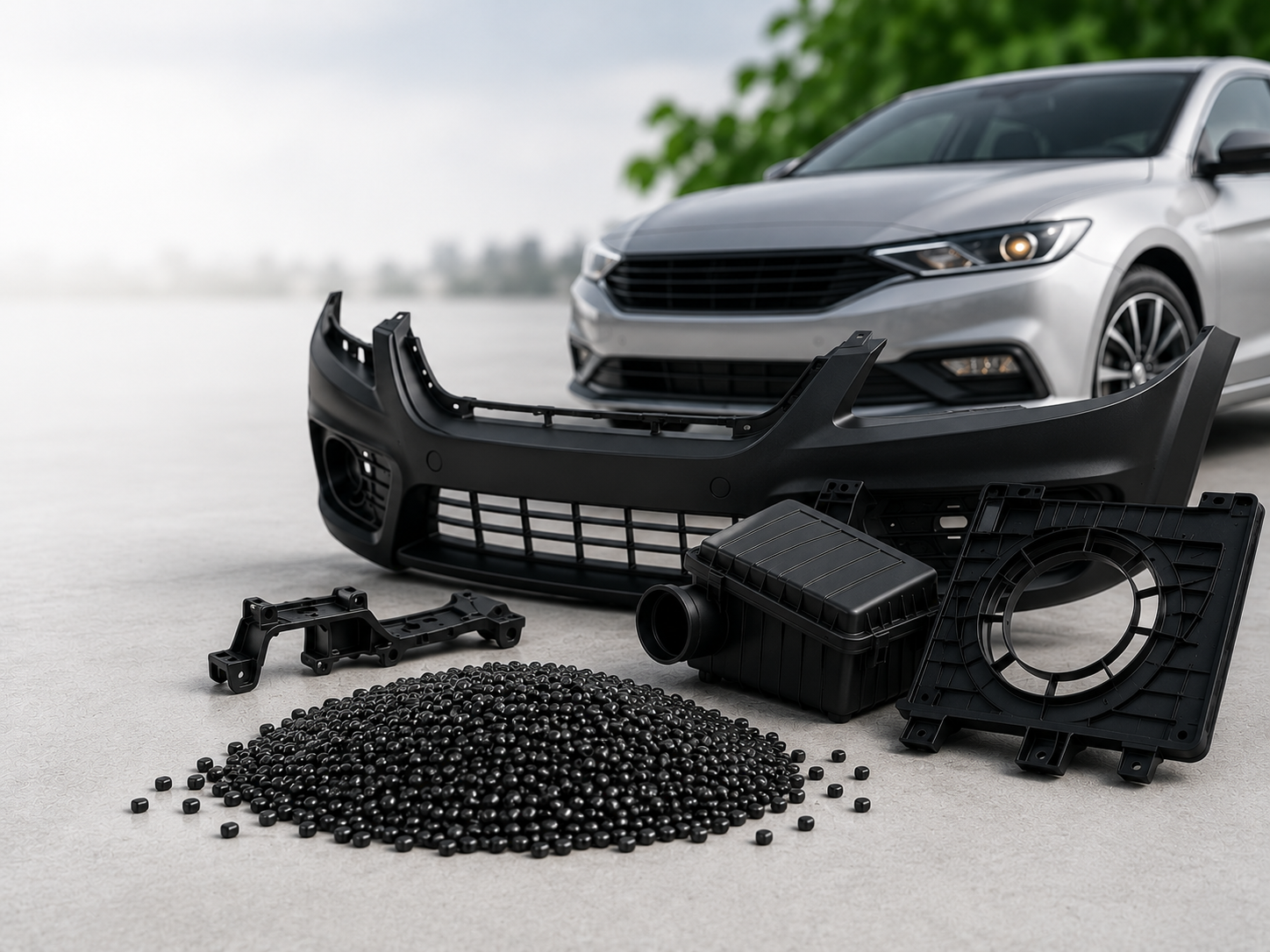
The automobile industry demands materials that can deliver a perfect balance of strength, durability, safety, and processing performance. Components such as dashboards, bumpers, interior trims, and structural plastic parts require polypropylene (PP) compounds with high impact resistance, dimensional stability, and consistent quality.
The Background
One of the major concerns faced by manufacturers was the availability of cost-effective PP materials that could maintain performance standards without excessive calcium carbonate (CC) filler loading. Many low-cost materials available in the market contained high filler content, which resulted in:
- Reduced impact strength
- Brittle performance during stress
- Surface and finishing issues
- Poor durability in automotive applications
- Inconsistent quality during molding processes
The client was already sourcing PP compounds, but the material failed to provide the required mechanical strength and stability needed for automotive-grade production.
Their requirement was clear:
“Develop a recycled PP solution with excellent impact resistance, controlled filler content, and reliable performance suitable for automotive applications.”
Additionally, there was a growing demand for materials that could also support FR (Fire Retardant) performance for selected applications within the automotive sector.
Our Approach
We started detailed formulation engineering and multiple industrial trials to create a specialized recycled PP compound designed specifically for automobile component manufacturing.
The development focused on achieving:
- High impact resistance
- Lower and optimized CC filler content
- Better toughness and flexibility
- Improved molding performance
- Consistent surface finish and dimensional stability
- Enhanced FR properties for added safety performance
- Sustainable utilization of recycled polymers
Instead of creating a low-cost substitute, our objective was to engineer a performance-driven recycled polymer capable of meeting practical automotive manufacturing requirements.
Extensive testing and process optimization helped us develop a material that maintained strength while delivering stable processing behavior during injection molding and component production.
The Outcome
The final recycled PP solution successfully addressed the client’s major concerns related to strength and filler-related performance issues.
The developed material delivered significantly improved impact resistance compared to previously used compounds, while maintaining better process consistency and component quality. The optimized formulation also supported improved FR characteristics, making the material more suitable for demanding automotive applications.
By reducing dependency on expensive virgin polymers and poorly performing high-filler materials, the client achieved both commercial and operational advantages.
This project demonstrated that recycled polymers, when properly engineered, can become reliable high-performance solutions for advanced industrial sectors like automobile manufacturing.
Today, the solution stands as a strong example of how sustainability and engineering innovation can work together to create next-generation automotive materials.
Process Gallery
.png)