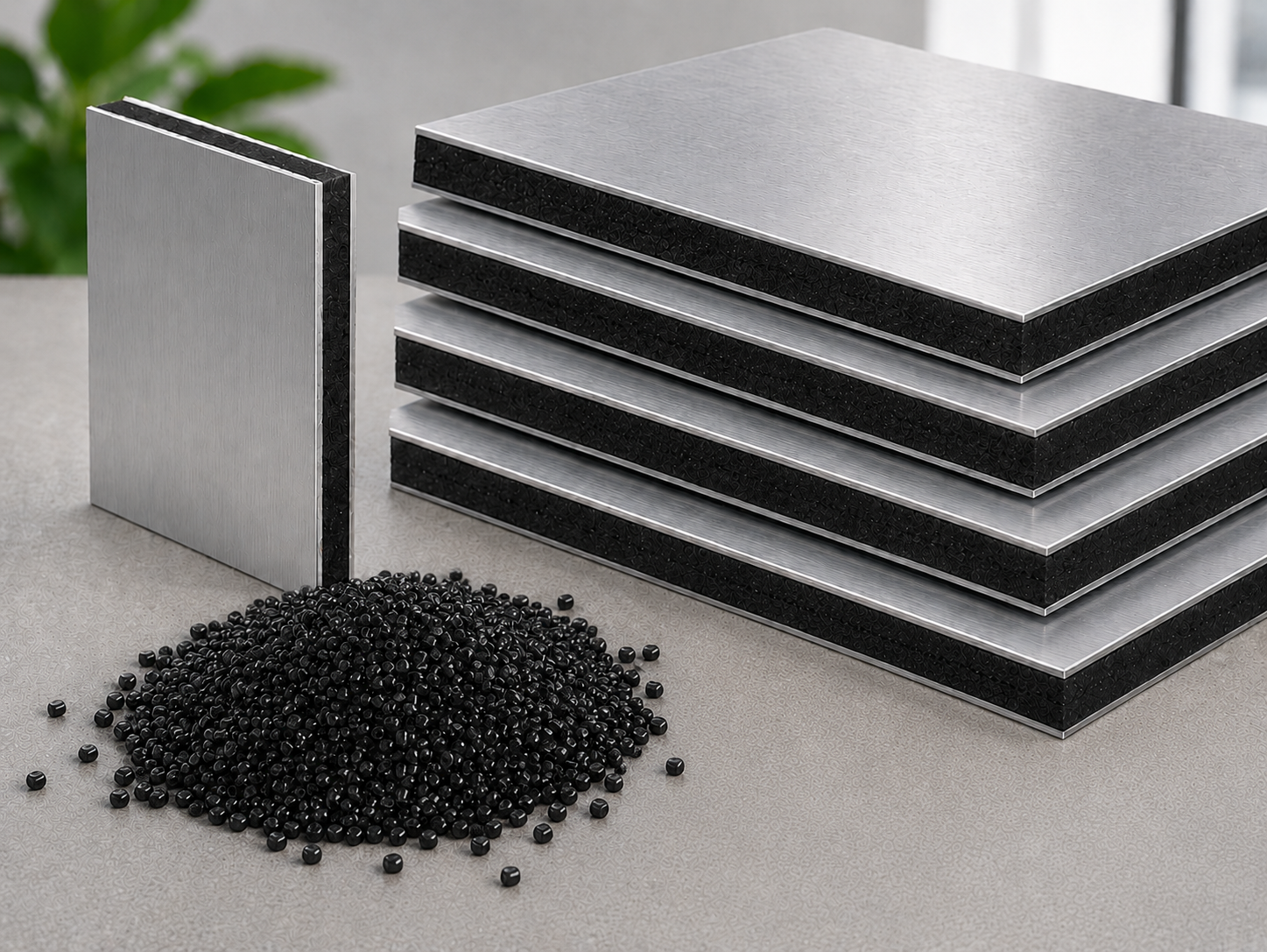
The Background
The ACP (Aluminium Composite Panel) industry has been rapidly evolving, with manufacturers constantly facing pressure to reduce production costs while maintaining product quality, safety standards, and durability. One of the biggest challenges in ACP manufacturing lies in developing the right middle-layer core material — a layer that directly impacts strength, fire resistance, bonding performance, and overall panel life.
Many manufacturers were dependent on expensive virgin materials or imported compounds that significantly increased production costs. On the other hand, low-cost alternatives available in the market often suffered from poor adhesion, inconsistent quality, weak FR properties, or processing issues during extrusion and lamination.
Our client approached us with a clear requirement:
“We need a highly economical RP-based ACP core material that delivers excellent sticking properties with aluminum sheets, maintains proper FR characteristics, and performs consistently during production.” This challenge became an opportunity for us to rethink how recycled polymers could be transformed into a high-performance industrial solution instead of being viewed merely as low-cost alternatives.
Our Approach
After detailed trials, formulation development, and multiple production evaluations, we engineered a customized recycled polymer compound specifically designed for ACP middle-layer applications.
The focus was not only on reducing cost, but on creating a balanced material that could deliver:
- Strong bonding and adhesion properties – ensuring excellent lamination with aluminum sheets.
- Stable FR-compatible performance – maintaining fire resistance without compromising extrudability.
- Smooth extrusion and processing behavior – consistent melt flow and dimensional stability.
- Consistent sheet quality – uniform filler dispersion and surface finish.
- Improved sustainability – high recycled content replacing virgin polymers.
By optimizing polymer compatibility, filler distribution, and processing characteristics, we created a solution that matched industrial requirements while remaining commercially competitive.
The Outcome
The developed ACP core solution successfully helped the manufacturer lower overall production costs without compromising functionality or reliability. The enhanced sticking performance improved bonding between layers, while the optimized FR formulation helped maintain desired safety standards.
Most importantly, the client achieved a more stable and scalable production process with reduced rejection rates and better operational efficiency.
This project demonstrated how the right engineering approach can convert recycled polymers into value-added industrial materials capable of competing with conventional solutions.
Today, the solution stands as an example of how sustainability, cost optimization, and performance can work together in modern ACP manufacturing.
Process Gallery
Key takeaways
High-performance industrial materials can be engineered from recycled polymers by focusing on compatibility, filler technology, and FR optimization. The right formulation not only cuts costs but also improves adhesion, fire safety, and process stability — proving that circular economy solutions can outcompete virgin alternatives in demanding construction applications.
.png)