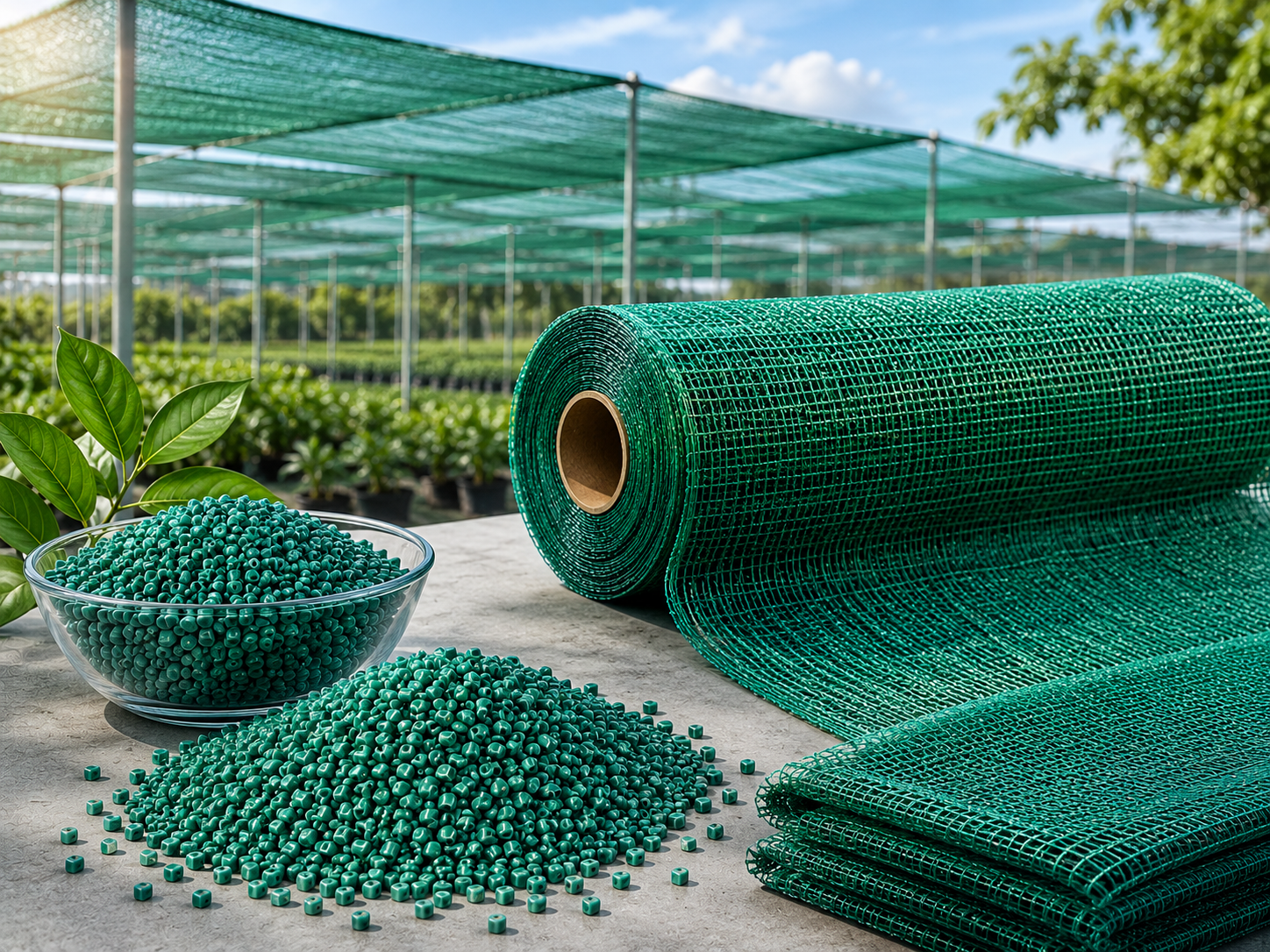
Green shade nets are widely used in agriculture, nurseries, greenhouses, and industrial applications where long-term outdoor durability and consistent performance are essential. Traditionally, manufacturers rely heavily on HDPE-based materials because of their strength, flexibility, and stretching properties.
The Background
However, with increasing raw material costs and growing sustainability awareness, manufacturers wanted to shift toward using 100% recycled polymers (RP) in shade net production.
The challenge, however, was extremely critical.
Most recycled polymer materials available in the market were unable to perform effectively during film and tape production processes. Manufacturers faced several major issues such as:
- Poor stretching strength during tape formation
- Weak tensile properties
- Frequent breakage during processing
- Uneven material flow
- Hole formation during film blowing
- Surface defects affecting final net quality
One of the biggest operational problems occurred during film blowing and stretching stages, where poor-quality recycled material would create holes in the film, leading to heavy production losses, rejection rates, and unstable manufacturing operations.
The client's requirement was ambitious:
"Develop a recycled polymer solution that can replace virgin HDPE usage as much as possible while maintaining stretching strength, process stability, and reliable film quality."
This required developing not just a recycled material, but a process-stable engineering solution suitable for continuous industrial production.
Our Approach
We conducted extensive polymer compatibility studies, processing trials, and formulation optimization to engineer a specialized recycled polymer compound for green shade net applications.
The key focus areas included:
- Improved stretching and tensile strength
- Better film formation stability
- Reduction in hole generation during film blowing
- Smooth processing behavior during extrusion
- Enhanced tape durability and flexibility
- Consistent batch quality
- Maximum utilization of recycled polymers without compromising performance
Special attention was given to melt flow consistency and impurity control, which are critical factors in successful film and tape manufacturing processes.
The objective was to help the client move toward sustainable manufacturing without disrupting production efficiency or final product reliability.
The Outcome
The developed recycled polymer solution successfully improved production stability and reduced the major issues previously faced during film blowing and stretching operations.
The material demonstrated better stretching performance, minimized hole formation, and delivered improved strength characteristics required for shade net manufacturing.
This enabled the manufacturer to significantly increase recycled polymer utilization while maintaining acceptable product quality and operational efficiency.
Beyond cost optimization, the project also helped the client strengthen their sustainability positioning by reducing dependence on virgin HDPE materials.
This case study became a strong example of how engineered recycled polymers can successfully enter technically sensitive applications like film and tape extrusion when supported by the right material science and process understanding.
Today, the solution represents a practical step toward more sustainable and commercially viable agricultural plastic manufacturing.
Process Gallery
.png)